

Your Type Doesn’t Matter
Why Systems Belong to Every Kind of Leader
A leader I work with recently told me she was struggling with the implementation of SYRENS™ 1 because the whole process felt “very Type A.” She said it carefully, almost apologetically, as if she was admitting something about herself that disqualified her from the work. She described herself as more Type B. Less rigid. Less driven by structure. More relationship-oriented and reflective than operationally intense.
It was an honest observation, and honestly, a useful one.
Because underneath her comment was something I think a lot of people quietly believe: that systems belong to certain personalities. That structured leadership is naturally for highly organized, fast-moving, hyper-disciplined people, while everyone else is just trying to survive inside a framework built by people unlike them.
The more I thought about it, the more I realized how strange that assumption actually is, especially once you understand where these personality “types” came from in the first place.
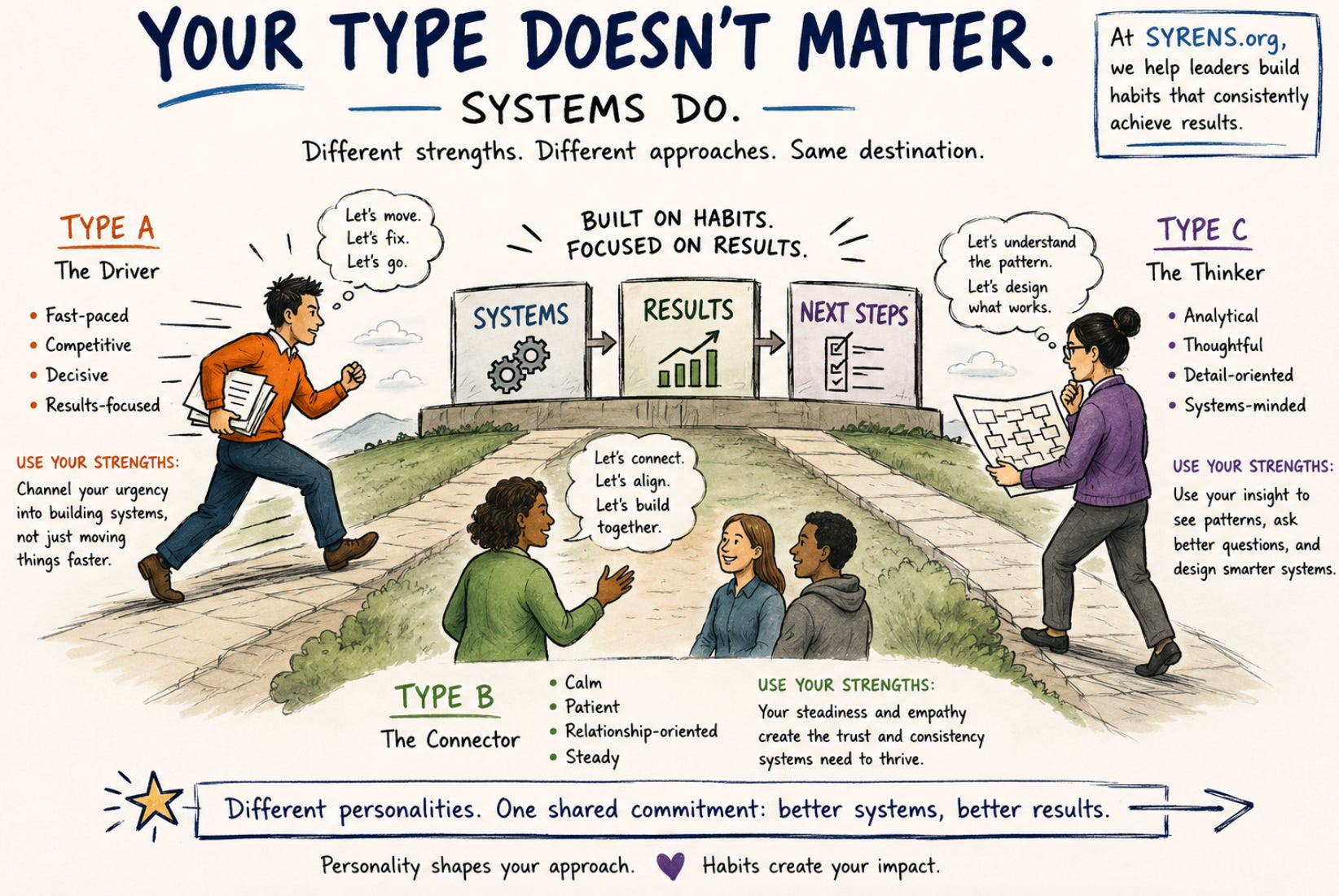
The origins of Type A and Type B had nothing to do with leadership theory, organizational development, or productivity culture. They came out of cardiology research in the 1950s. Cardiologists Meyer Friedman and Ray Rosenman were studying patterns among patients with heart disease when they noticed that certain people consistently displayed similar behavioral tendencies. These patients tended to move quickly, interrupt often, operate with urgency, compete intensely, and struggle to slow down. The researchers labeled this cluster of behaviors “Type A.”
The opposite pattern became known as Type B. More patient. More relaxed. Less externally driven by urgency and competition. Over time, broader discussions introduced the idea of Type C personalities as well, often describing people who are thoughtful, emotionally restrained, analytical, conflict-avoidant, or deeply internal processors.
What began as a medical observation eventually escaped into mainstream culture, and somewhere along the way business culture quietly decided that Type A was the preferred setting for leadership.
You can see it everywhere. Fast leaders get praised. Busy leaders get promoted. High-intensity personalities are often interpreted as more committed, more capable, or more serious. Entire organizations begin shaping themselves around urgency and velocity, often confusing movement for effectiveness.
But organizations are rarely failing because they don’t have enough Type A personalities.
More often, they are failing because they lack consistent habits.
That’s a very different problem.
One of the foundational ideas behind SYRENS™ is that a system is simply a set of habits that consistently achieves a set of results. That definition matters because habits are adaptable. Personality is relatively stable. Habits can be learned, strengthened, refined, and repeated by almost anyone willing to commit to them.
The leader I was speaking with had unintentionally fused structure with personality. She believed the system itself belonged to a different kind of person. But SYRENS™ was never intended to turn everyone into the same type of leader. In many ways, it does the opposite. It creates enough clarity and rhythm that leaders can operate from their natural strengths without the organization collapsing into inconsistency.
Type A leaders often thrive in the early stages of systems work because they naturally create momentum. They push for action. They move quickly. They tend to see gaps and inefficiencies immediately. In struggling organizations, that energy can feel lifesaving. But Type A leadership also comes with predictable risks. These leaders often over-own problems, step in too quickly, and unintentionally create systems that depend on their personal force instead of shared habits. The organization functions because they are constantly compensating for weak systems.
SYRENS™ can actually help Type A leaders slow down enough to build sustainability. It forces clarity around ownership. It shifts the focus from heroic effort to repeatable practice. For highly driven leaders, the challenge is often learning restraint, not intensity.
Type B leaders bring something organizations desperately need but often undervalue: steadiness. They tend to regulate emotion well, create psychological safety, and maintain perspective when others escalate. Teams often trust them because they don’t lead through pressure alone. In many environments, that calm presence becomes stabilizing. The problem is that Type B leaders sometimes interpret structure as artificial or emotionally disconnected, when in reality structure can protect relationships by making expectations clearer and reducing confusion.
For Type B leaders, SYRENS™often becomes a support system for follow-through. Instead of relying on emotional energy or interpersonal instincts alone, recurring habits carry part of the workload. Systems, results, and next steps create enough consistency that the leader does not need to become someone louder or more intense in order to lead effectively.
Type C leaders may be the most underestimated systems thinkers of all. They often notice patterns others miss. They reflect deeply. They think carefully about implications and interdependencies. In organizational work, those are enormously valuable traits. But Type C leaders can also get trapped in overanalysis, waiting for complete certainty before moving forward. They may privately refine ideas long after the moment for action has passed.
The structure of SYRENS™ helps interrupt that paralysis by normalizing iteration. The “next steps” mindset matters because it creates movement before perfection. It reminds leaders that systems are built through repeated adjustments, not flawless planning.
What all of this ultimately points to is something simple but important: organizations spend far too much time treating personality as destiny.
“I’m just not structured.”
“That’s not how I lead.”
“I’m more relational.”
“I’m more creative.”
“I’m not operational.”
Most of the time, those statements are partially true and partially protective.
Because without systems, organizations become dependent on personality. Meetings depend on mood. Accountability depends on who is in the room. Communication depends on memory. Progress depends on a handful of highly functional people carrying everyone else.
A Type A leader can stop carrying the entire organization through force of will. A Type B leader can lead with calmness without drifting into ambiguity. A Type C leader can think deeply without getting stuck in endless refinement. Not because they changed who they are.Because they developed habits strong enough to support who they already were.
SYRENS™ is a leadership-led systems implementation process - see syrens.org for more