

File This One Away
Why the best organizations use internships to build culture, clarity, and renewal
Both of my daughters went to schools built around co-op and internship experiences. One attended Rochester Institute of Technology and the other attended Northeastern University, two universities that long ago figured out something many organizations still miss: people learn work by doing real work around real people. And in both cases, the internships turned into employment (whew!)!
That wasn’t luck. It was exposure. Repetition. Trust. It was the result of organizations letting young people move from observer to contributor while also allowing the organization itself to adapt in response.
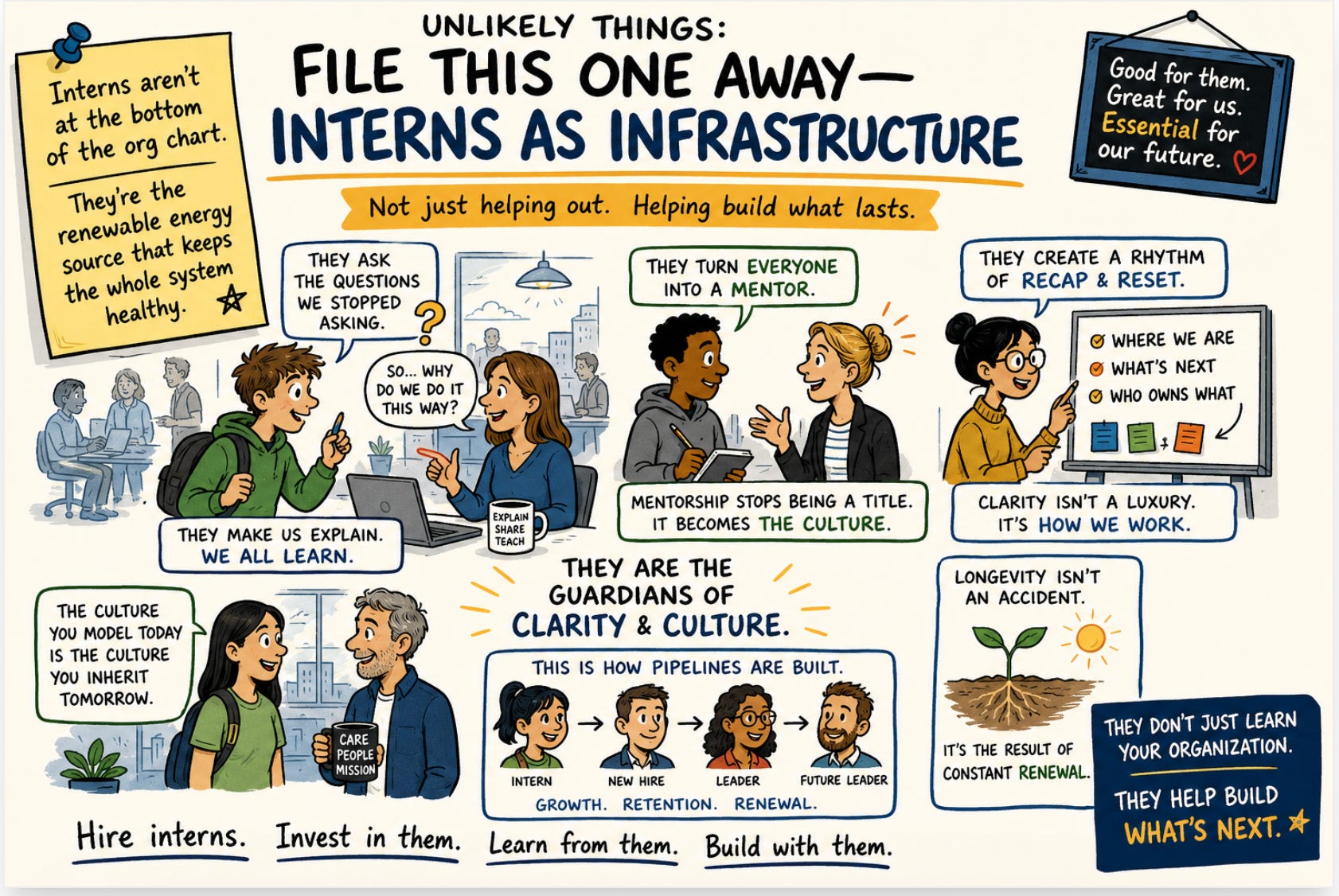
Most companies talk about leadership development like it’s some mystical multi-step recipe involving retreats, binders, trust falls, and a conference room with carpet that really should’ve been replaced in 1998. But the more organizations I spend time in, the more I keep bumping into the same truth: the most reliable leadership engine out there isn’t a sophisticated program at all. It’s interns. Yes, interns.
The people we usually associate with iced coffees, filing color-coded folders, and the heroic ability to smile through jargon they definitely don’t understand yet. But here’s the unlikely thing: an intern-heavy workplace can become one of the most powerful culture-shaping, learning-accelerating environments you can build. Most leaders don’t see the magic because they’re looking in the wrong direction.
Companies like Fidelity Investments have built enormous talent pipelines through internships and co-op partnerships for years. Interns don’t just shadow people there, they become integrated into teams, workflows, and long-term recruiting strategies. Organizations like Security Risk Advisors historically used internship structures similarly, creating environments where younger employees learned the organization while the organization continuously renewed itself through fresh talent and perspective. Tech firms, engineering companies, hospitals, design agencies, and increasingly smart school systems have all discovered versions of the same truth: when interns are embedded well, they don’t slow learning down, they accelerate it.
Because when interns walk into the room, the whole system shifts.
People slow down just enough to narrate what they’re doing. They explain decisions that everyone else stopped questioning years ago. Suddenly you hear things like, “So the reason we do it this way is…”—a sentence that hasn’t surfaced since the Obama administration.
The interns are learning, sure, but so is everyone within earshot. Not through formal PD. Not through awkward “raise your hand if you’re confused” moments. Just by being present when someone explains a system out loud for the first time in ages.
That’s the quiet brilliance of it: a workplace with interns becomes a teaching hospital disguised as an office. And the employees may benefit the most.
Interns can also force something else to happen: everyone becomes a mentor long before they feel ready. New hires, who usually spend their first few months trying to look confident while silently Googling acronyms, suddenly have someone looking to them for cues. Someone watching how they communicate, organize their work, and handle pressure.
That gaze sharpens people.It pulls out their best professional self faster than any onboarding packet ever could. Mentorship stops being a title and becomes an expectation baked into the culture. Everyone is modeling something for someone.
And because interns rotate in and out, they create a natural rhythm of recap and reset. Most organizations struggle to pause long enough to explain where they are and why. Interns make you do it. They require clarity, not because teams suddenly love documentation, but because interns need enough context to contribute.
Fresh eyes demand fresh explanations.
That ongoing act of sensemaking keeps the system crisp. Interns become accidental guardians of clarity. They expose fuzzy communication, weak onboarding, confusing processes, and meetings where nobody actually knows who owns the next step. They stumble over the parts of the system everyone else has learned to quietly step around.
They’re also guardians of culture. There’s something about being watched by a nineteen-year-old that makes everyone behave a little better. You don’t want to become the story an intern tells later as an example of what professional dysfunction looks like. You want to model what it looks like to care about the work, the people, and the mission.
And because many interns eventually become employees, the culture you model today becomes the culture you inherit tomorrow. That’s the long game.
I was in an organization recently where every month a group of people celebrated milestone anniversaries, three years, five years, ten years, even fifteen. Not because they were stuck, but because they were connected. The organization kept renewing itself. Interns came in. Interns grew. Interns asked fresh questions. The place never calcified because curiosity kept entering the system.Longevity is the result of constant renewal.
And nothing renews an organization like a steady influx of curious, brave, unpolished interns asking the questions everyone else forgot to ask.
If you want a workplace where people grow, stay, and step into leadership, hire interns. Then pay attention to what happens next. They’ll change your organization quietly, consistently, and in all the ways that matter.